Be like A-Kiva

I was at an Amazon fulfillment center tour last summer, where they bring you into the warehouse and show you how their packing system works, and how quick and efficient it is. Amazon globally produces over 200 packages a second, every second.

It takes a mix of people, many different types of robots, and miles and miles of conveyor belts, all coordinating to bring the item from the shelf, to the delivery truck.

As we were walking between the conveyor belts – so close you can touch them – and near the robots, with packages moving at high speed all around, I knew that there are countless lessons in serving Hashem to be learned from all these systems, but one system stood out from the rest:

One of the most striking features, on the 3rd floor, are the moving robots, invented by Kiva systems.

Each robot carries a shelf full of different products, and it moves around the floor, to different packing stations, depending on if a product it carries is needed here or there.

There are hundreds and hundreds of these robots moving at the same time on the same floor! They scan qr codes on the floor and that keeps track of where each robot is, so they don’t bump into each other.

It’s a fascinating thing to watch and it carries an important lesson.

Coming from the days of Sefiras Ha’omer, and 50 years since the 12 Pesukim, the words of Rebbi Akiva – that the love of a fellow Jew is a central principle in the Torah – come to life.

Being unified in such a way that we all complement each other in the bigger picture, and never ever getting in anyone’s way while doing so.

These robots stay focused on their mission and don’t disrupt each other, because at every moment they account for each other – where they are, where they are going, what they are up to – and that is the key to their success.

If we would stop and think about those around us periodically – with the purpose of simply making a note of them – we would have much more sensitivity while we go about our own mission.

in short: be like a Kiva!

The same new screen

This is one of my favorite הוראות (lessons in serving Hashem) from technology!

As you scroll through this article, you’ll see the words on the page moving as you scroll. A screen is made up of tiny little light bulbs that change colors based on what it needs to show. The light bulbs can change very quickly, usually 60 times a second (or 60 hertz, or 60hz).

But when you stop scrolling, the lightbulbs creating the words on the page aren’t changing at all. Right?

Well, not really. There is a world of action in a non-moving screen. Each bulb needs an electrical pulse keeping it alive, once every microsecond (about a million times faster than the tick of a clock).

Older screens are even more astounding to me. Every single second the entire screen is refreshed 60 times. If you were to take a high speed camera (a ridiculously fast one), you would basically see a black screen and one little line of the screen turned on at any given moment. The speed is so fast that it gives the illusion that the screen is displaying something.

This is a powerful lesson in המחדש בטובו בכל יום תמיד מעשה בראשית (that Hashem is constantly recreating the entire world), and makes this concept a bit more relatable.

The world your eyes saw a moment ago is a different world that you see now. Just like the (older) screen, it looks like the same thing from before, but in reality it’s totally new. Or, learning from a modern screen, we can appreciate לעולם ה’ דברך נצב בשמים, that there is a continuous divine pulse behind every single element in creation, and if that pulse goes away, the screen/world goes back to nothingness.

The Rebbe brings down this idea often, and learns that because each person is newly created each and every moment, it doesn’t matter what you’ve been up to up until now, you are a brand new creation! Go do something positive!

One thing at a time

You’ll be surprised to know that a computer can only do one thing at a time. Only one. Really!

Sometimes, your computer chip might contain multiple “cores”, but at the core level, it can basically do only one thing at a time.

You may ask, “So does my computer use 10 cores when I have 10 programs open at the same time?”, and the answer is “No”.

So how can the computer “multitask” by doing so many things simultaneously?

The answer is – that it’s able to only do one thing at a time, but it’s able to do that thing very fast. Extremely fast! Like 0.3 nanoseconds fast!

(How quick is 0.3ns? Blink your eyes. That just took about 3 million times longer than 0.3ns)

By doing its tasks quickly, it is able to finish one thing and move on to the next thing so quickly, that it looks like 2 things happening at once.

This reminds me of what the Rebbe said in the name of the Frierdiker Rebbe who related what the Rebbe Rashab told him about what the Rebbe Maharash told over: That hatzlacha bizman, success in time management – since you can’t increase the available hours in a day – is by focusing on the current task at hand, even if a moment later you will need to do another task, but at the present moment, nothing else in the world matters.

see כ’ שבט תש”ל, and תו”מ – רשימת היומן ריש ע’ שסז. וש”נ

Every letter, a must-have

The Baal Shem Tov taught that from everything you hear or see in this world you must find a teaching in how to serve Hashem.

A computer needs instructions to work. Those instructions are written in computer language called code. A computer will execute (run a program, do a calculation etc.) whatever you command it to do (which may be a lesson in Kabbolas ol or Merkava, for another time…).

The way a computer follows that code, has an interesting lesson for us.

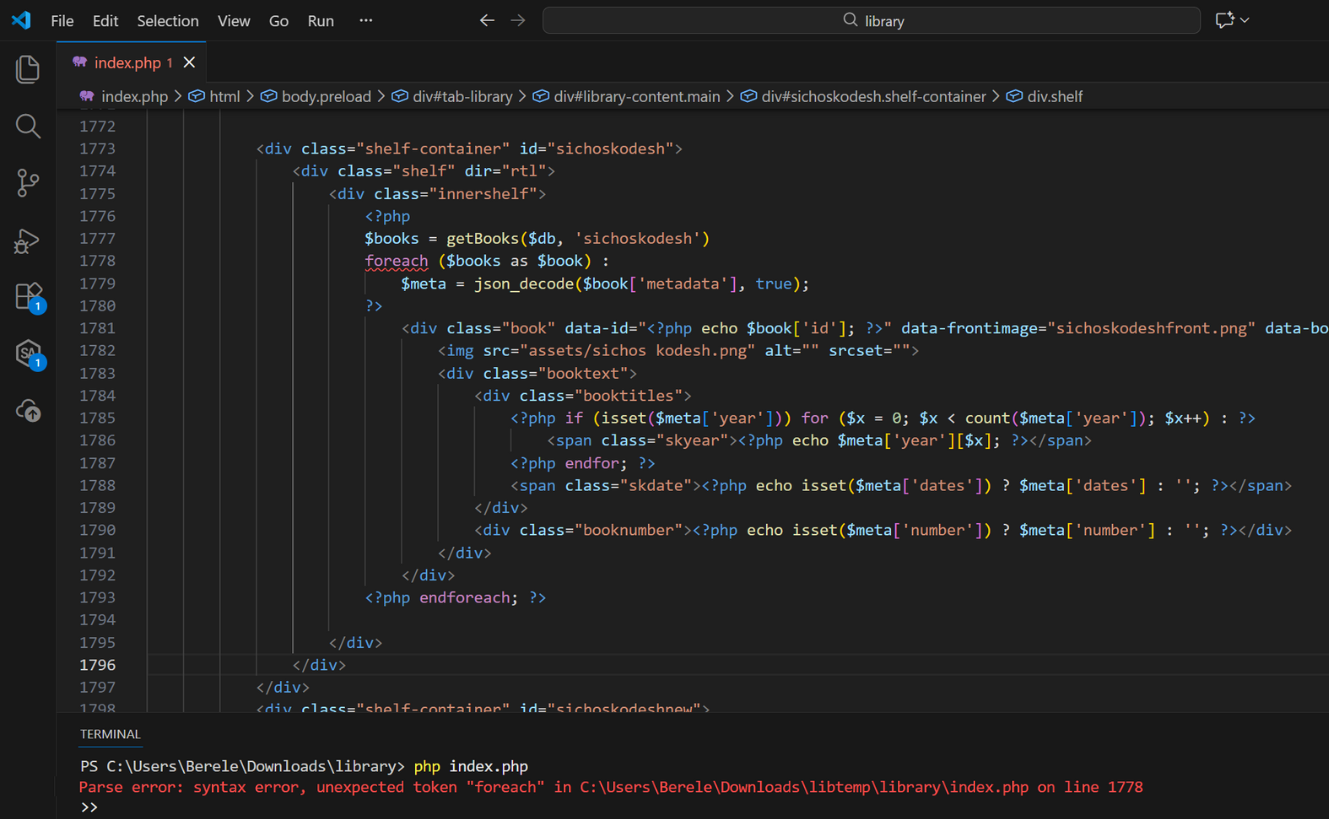
Consider the following code (in PHP, my favorite programming language):

<?php
print("Hello, Berel!");
print("How are you today?");

This will cause the screen to display: Hello, Berel! How are you today?

What if I ran this code instead:

<?php
print("Hello, Berel!")
print("How are you today?");

The screen would show Parse error: syntax error, unexpected ‘print’ (T_PRINT) on line 3.

That’s not what we wanted! That’s an error!

Can you spot the difference between the 2 snippets of code above?

In the second example, the first line is missing the ; (semicolon) at the end of the line. But why does that matter so much? The commands look the same, and you can certainly figure out the code just by looking at it for a half a second.

But a computer works differently. It must have each and every letter in the correct place for it to work properly, otherwise it can’t understand the code and the program will crash (or actually crash, in the case of a NASA rocket which crashed because of a missing hyphen (-) in 1962!)

This concept existed way before computers. We all know that for a Torah to be Kosher, it must have every single letter, and they must all be intact; not rubbed out, not cracked etc.

You would think that a missing letter is not the biggest deal, after all, the meaning of the Torah might still be the same, and at the very least you can infer what the Torah wanted to say…

We see, however, that the Torah is more than letters on a scroll. There is a current behind each letter, connecting it to every other part of the Torah, and when one is missing, every other letter cannot perform their task, not even a part of their task!

There are unique lessons to be learned from this – about the unity and necessity of every Jew etc.

One aspect to highlight, which is relevant every moment of our lives, is to recognize, that the entire world depends on your action, no matter how big or (seemingly) small, and without it, the world cannot function the way Hashem wants it to. And when we act the right way, it has the potential to complete the entire mission, just like fixing the bug, fixes the issue instantly, and fixing the letter in the Torah, makes the entire Torah instantly Kosher!


Notes:

  1. The Torah is even more precise. In code, if you make a typo, for example:

    <?php
    print(“Hellos, Berel!”);

    This will work, even though the word Hello is misspelled. (I’ll leave it to you to figure out why it would still work). But in a Torah, any letter, even from a simple conversation, must be precise.
  2. Here are some places where the Rebbe speaks about needing every letter in a Torah, with a unique lesson:
    1. ש”פ ויקרא תש”מ (שיחות קודש תש”מ ח”ב ע’ 530)
    2. ש”פ משפטים תשכ”ח (שיחות קודש תשכ”ח ח”א ע’ 407)
    3. מכתב כללי כ”ה אדר תשמ”ב (לקוטי שיחות חכ”ב ע’ 258)
  3. The year תשמ”ב is like this year’s kvius (calendar schedule), and the Rebbe is constantly pushing everyone to buy letters in a Sefer Torah, and to make sure that every single Jew owns a letter in the Unity Sefer Torah. Many chassidim are learning these farbrengens this year, and that is the reason that this blog is starting with this article. My biggest passion is to influence as many as possible to watch/listen/learn the Rebbe’s Farbrengens more and more often!